Today in News History
On June 23, several notable moments in the history of News stand out. In 1305, A peace treaty between the Flemish and the French is signed at Athis-sur-Orge. In 1758, Seven Years' War: Battle of Krefeld: British, Hanoverian, and Prussian forces defeat French troops at Krefeld in Germany. In 1901, Ahmet Hamdi Tanpınar, Turkish author, poet, and scholar (died 1962) was born. In 1931, Ola Ullsten, Swedish politician and diplomat (died 2018) was born. In 1941, The Lithuanian Activist Front declares independence from the Soviet Union and forms the Provisional Government of Lithuania; it lasts only briefly as the Nazis will occupy Lithuania a few weeks later. In 1951, The ocean liner SS United States is christened and launched. In 1954, Salih Omurtak, Turkish general (born 1889) passed away. In 1961, The Antarctic Treaty System, which sets aside Antarctica as a scientific preserve and limits military activity on the continent, its islands and ice shelves, comes into force. In 1967, Cold War: U.S. President Lyndon B. Johnson meets with Soviet Premier Alexei Kosygin in Glassboro, New Jersey for the three-day Glassboro Summit Conference. In 2014, The last of Syria's declared chemical weapons are shipped out for destruction. Together, these milestones provide historical context for today's news news and ongoing narratives.
JUST IN: 🇮🇷 Iran says it will maintain control of the Strait of Hormuz in any permanent deal w [...]
JUST IN: Iran says it will maintain control of the Strait of Hormuz in any permanent deal with the US.@BRICSNews
Narrative Intelligence Brief
This article was published by BRICS News, a source frequently categorized with a center bias based in Russia. Our narrative intelligence engine continuously monitors coverage from this outlet to track framing, bias, and rhetorical patterns. Our initial algorithmic scan of this specific piece did not flag high-confidence rhetorical techniques, suggesting a generally straightforward reporting style or neutral framing. By understanding the editorial perspective of BRICS News, readers can better contextualize the information presented and compare it across our broader media matrix to find the real narrative.
More from BRICS News
June 23, 2026
[Photo] JUST IN: 🇰🇵 Kim Jong Un calls to expand North Korea's nuclear arsenal to 'ov [...]
June 23, 2026
[Photo] JUST IN: 🇰🇵 Kim Jong Un calls to expand North Korea's nuclear arsenal to 'ov [...]
June 23, 2026
JUST IN: 🇮🇷 Iran says it will maintain control of the Strait of Hormuz in any permanent deal w [...]
June 22, 2026
JUST IN: 🇮🇷🇺🇸 Iran shipped 30,000,000 barrels of crude oil in the past week, before US lifted [...]
June 22, 2026
JUST IN: 🇮🇷🇺🇸 Iran shipped 30,000,000 barrels of crude oil in the past week, before US lifted [...]
Analysis Methodology
This narrative analysis was generated using the CoDataLab Global Intelligence Engine. Our proprietary AI scans thousands of cross-border sources to identify sentiment patterns, framing techniques, and potential media bias. While AI provides the data-driven foundation, our objective is to empower readers with additional context beyond the standard headline.The content displayed above is a structured summary designed for rapid information processing. For the full original report, please visit the source outlet.More Coverage
Discussion
"prime"
Trump Administration Scrambles After Vance’s Embarrassing Snub Video

Kemi Badenoch breaks silence after Starmer’s resignation, reveals what she says is Labour’s real problem

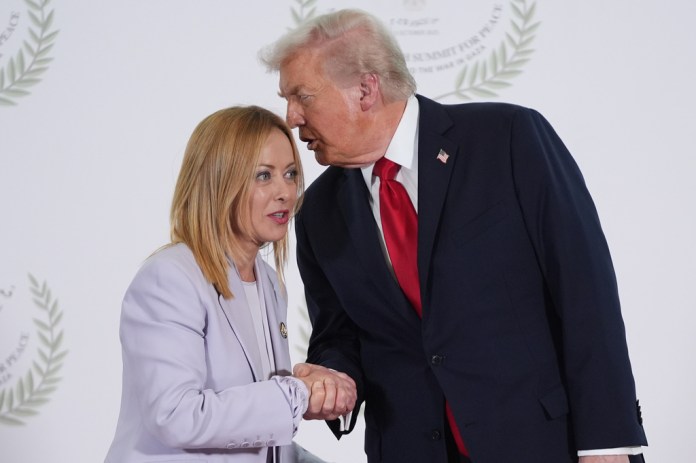
Trump’s foolish rebuke of Italy’s Meloni